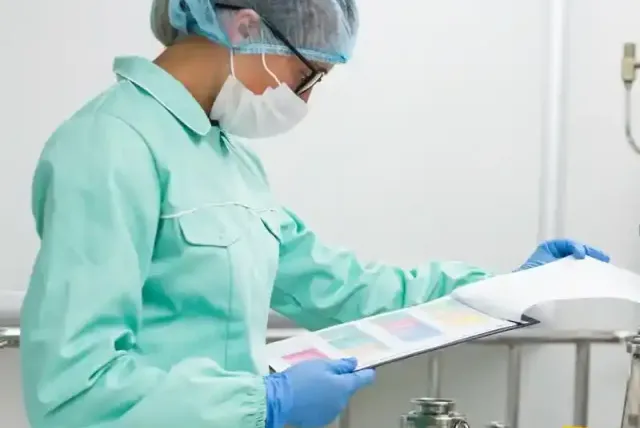
The sterility of a pharmaceutical product can only be assured when a series of control measures are in place. The sterility test applied to the finished product does not guarantee sterility as only a small part of the batch is tested.
Participants will gain a thorough understanding of the relevant regulatory requirements, sterility assurance measures, and sterility assurance concepts, which helps to develop a critical attitude towards the development and manufacture of sterile products. Including the new Annex 1!
Target Audience
Professionals in pharmaceutical and biotechnological industries, Professionals in institutions and Contract Research Organisations (CRO’s), Hospital pharmacists and Postgraduate students.
The course is aimed at (young) professionals in non-clinical and clinical development of new medicinal products, production, packaging, Quality Control, Quality Assurance or Regulatory Affairs who are dealing with complex quality systems. The target audience needs to gain an in-depth understanding of these systems to improve quality management in their own organization.
The course is an international training program in English and requires, at minimum, a Bachelor’s Degree level (HBO level in the Netherlands).
If you're a pharmacist or hospital pharmacist interested in earning accreditation points by attending this training,
New Accreditation Request
Read the disclaimer and complete the form below.
Disclaimer
Please note that PCS will only submit an accreditation request to the relevant accreditation institutes if three or more pharmacists or hospital pharmacists have registered, submitted an accreditation request, or have a pending reservation for a training session.
Requesting accreditation is costly for PCS, both in time and money, with costs per request ranging between four and five hundred euros. We aim to avoid making such requests without sufficient reason. Therefore, we kindly ask you to carefully consider before requesting accreditation.
Accreditation is evaluated by the NVZA and KNMP based on multiple factors, and it is not clear in advance how many accreditation points will be granted. No rights can be derived from your accreditation request as a participant. There is a possibility that no accreditation will be granted at all.
PCS reserves the right not to submit an accreditation request for any reason, which may not be disclosed to the participant. PCS's decision in this regard is final. PCS is not liable for any losses or damages resulting from the failure to obtain accreditation. We reserve the right to change our accreditation policy at any time without prior notice.
Criteria
Only pharmacists and hospital pharmacists may request accreditation.
Deadline
Accreditation requests will only be processed if made more than four weeks before the start date of the training.
(University) Students
Master students get a discount of 25% per module/training.
Results
After having followed this course, you will be able to:
Apply the principles of specific sterility-related subjects, such as monitoring, cleaning and disinfection, sterilization, and validation.
Interpret the guidelines and common practices, and distinguish these facts from myths.
Demonstrate a critical attitude towards sterility assurance in sterile manufacturing.
After having followed this course, you will have:
A thorough understanding of the design and control factors related to the sterility assurance of sterile pharmaceutical products.
Gained the principles of specific sterility-related subjects, such as monitoring, cleaning and disinfection, sterilization, and validation
Interpret the guidelines and common practices, and distinguish these facts from myths
A critical attitude towards sterility assurance in sterile manufacturing
Contents
Microbiology and implications for sterility
Sterile manufacturing set-up
Process and facility
Sterilization (steam, dry heat, filtration and others)
Cleaning and disinfection
Cleanroom behavior
Pharmaceutical water systems and utilities
Control
Environmental and water monitoring
Sterility assurance in practice
Validation and qualification (aseptic and analytical methods, operator qualification)
Releasing the sterile product: The role of the QP in assuring the quality of sterile pharmaceuticals
Real-life case studies
Program
Lecture
Day
Welcome and outline of the course
1
Biology of microorganisms
Implications for pharmaceutical production and quality control
1
Sterile manufacturing: a philosophy on design and control
1
Environmental monitoring
Case study
1
Pharmaceutical water systems and utilities
1
The gowning procedure
1
Lecture
Day
Sterilization methods: steam, dry heat
Exercises for steam
2
Cleaning and desinfection
2
Sterilization methods: Filtration and alternative methods
2
Case studies: Sterility Assurance in practice
2
Contamination Control Strategy
2
Lecture
Day
Validation of aseptic processes
Case studies
3
Aseptic operations in ATMP manufacture
3
Workshop: the role of the QP in assuring the quality of sterile pharmaceuticals
3
Evaluation of the course
3
Quality Course modules
This module is part of a series called: "Quality Management in Pharma and Biotech". This series is designed to give participants an in-depth understanding of the QP’s role and responsibilities. See the other modules in this series below.
Group discounts are only applicable when multiple participants register for the same course at the same time.
Language (upcoming edition):
English spoken language (primary)
Dutch spoken language (secondary)
Some lectures/lessons may be in the secondary language. The primary language remains the dominant spoken/written language during the training.
Learning form:
Classroom
Times:
Starts at approx. 09:00 and ends at approx. 17:30
Requires preparation:
Yes.
This module contains homework. The homework will be provided prior to the training.
Includes exam:
Yes.
Exam price:
€350.00 ex. VAT per participant.
Notes to the course dinner:
The course dinner takes place on day 2.
Lecturers
Wilma Meijs
Trainer
Wilma Meijs is an experienced consultant and director with more than 25 years of experience in th...
Trainer Profile
Wilma Meijs
Biography
Wilma Meijs is an experienced consultant and director with more than 25 years of experience in the pharmaceutical industry. She has a strong focus on GMP, GxP and Quality Management Systems, and extensive experience in QA, QC and QP roles within both small molecule and biotechnological environments.
Since April 2011, Wilma has been the owner of Wilma Meijs Farmaceutisch Advies BV, where she supports pharmaceutical companies with GxP compliance. Her activities include validation projects, acting as a Qualified Person (QP), implementation and improvement of Quality Management Systems, performing audits, and developing and delivering training programmes.
Previously, Wilma held various QA, QC and management positions at, among others, Intravacc, Abbott Biologicals, PCS, the Netherlands Vaccine Institute, AMT Biopharma, Merck Sharp & Dohme, Biogen Idec and Teva Europe.
Wilma obtained her PhD at Vrije Universiteit Amsterdam and combines her academic background with extensive hands-on experience in quality assurance and pharmaceutical manufacturing.
Expertise and Services
GMP & GxP
Quality Assurance & Quality Control
Qualified Person (QP)
Validation of processes, cleaning and equipment
Implementation of Quality Management Systems
Auditing (internal and external)
Training & coaching
Risk assessments and environmental monitoring
Positions
Consultant & Director – Wilma Meijs Farmaceutisch Advies BV (2011–present)
Astrid Bulsink is a senior consultant and project manager with over than 35 years of experience i...
Trainer Profile
Astrid Bulsink
Biography
Astrid Bulsink is a senior consultant and project manager with over than 35 years of experience in quality management and process optimalisation within the pharmaceutical and (biotechnological) industry. She has extensive expertise in GMP and Quality Management Systems in regulated environments.
Since 2006, Astrid has been the owner of dArtis Consultancy, where she supports organisations in the design and optimisation of Quality Management Systems, project management, training and coaching. In addition, she works together with PCS as a Trainer, Consultant and Auditor.
Previously, Astrid held (international) managerial positions at, among others, Wyeth, Centocor, Chiron Corporation and HAL Allergy Group.
Expertise and Services
Quality Assurance and Quality Management (GMP)
Pharmaceutical automation and laboratory systems
Project management and process improvement
Design and optimisation of Quality Management Systems
Training and coaching
Auditing
Positions
Senior Consultant Pharmaceutical Quality Systems – dArtis Consultancy (2006–present)
More interactivity during the presentations, using a mic and more workshop especially for EM.
Amber - Consultant
5 out of 5 stars
Strong points (and why):
Comprehensive explanations and presentations per topic, active interactive case studies.
Review:
Even more case studies! Especially on QP decision making related to the topic.
Marion Chomet - QP in training
4 out of 5 stars
Strong points (and why):
The engagement/workshops to keep it from becoming one long lecture. The case studies of the QP.
Review:
Grammar/spelling mistakes on the slides.
Fercan - Student
5 out of 5 stars
Strong points (and why):
We were open to ask.
Review:
Presenters Using a microphone.
Anonymous - Anonymous
4 out of 5 stars
Strong points (and why):
Switch between theorie and interactive.
Review:
Do not invite inexperienced speaker. The hospital guy said so much "uuuuuhhh" that I lost my attention span after 15min. Thank you, it was a nice experience!
Quinten van Erp - Qp in training/ quality specialist III
4 out of 5 stars
Strong points (and why):
The phase is OK. The trainers are knowledgeable.
Review:
Use microphones, the design of the workshops (should give more technical info).
Gianne - Head of QA
4 out of 5 stars
Strong points (and why):
All the theory and the practice coming together in the end.
Anonymous - Anonymous
4 out of 5 stars
Strong points (and why):
Discussions with experts on different topics.
Review:
Maybe 2 day training as some parts were a bit on a basic level while others are for professionals with experience in gmp/sterility.
Mohamed - QP
4 out of 5 stars
Strong points (and why):
Case studies / workshops and the opportunity to ask questions during the training sessions.
Review:
Check the presentation slides; grammatical errors and spelling errors every 2-5 slides.
We use cookies to improve your experience, analyze website usage, and show you relevant information. By accepting all cookies, you help us improve the website. View our privacy statement.
Cookie settings
Necessary
Always active. Required for the website to function properly.
Statistics
Helps us improve the website through anonymous statistics.